Now also available via Tor
http://iwccx6ebuapto7dlkd4m5fooud6nqn2z7go7aass5c4q6vl6gzs5htad.onion/
Posts in category tech
-
Verilog: How does a CPU actually work?
Verilog series
A.k.a. “What’s a fetch-decode-execute” cycle?
So, yeah, I studied electrical engineering, and I learned about the usual CPU execution cycle, and the CPU architectures von Neumann vs. Harvard, but I never really thought much about it, it was always very abstract.
Now, with my Verilog experiments, I could dig deeper into this. I implemented both the Nandgame CPU and Ben Eaters 8 bit breadboard CPU1.
The Nandgame one was easy, as fetch/decode/execute would happen basically within one cycle. (Harvard2 architecture).
However, with the Ben Eater CPU (von-Neumann) architecture, things get a bit more involved. In his video series, Ben used an EEPROM to manage the execution. But I thought I can do better! With a Finite State Machine! The states usually go like
    PC_to_MAR <-----\  Get contents of program counter,
       |            |  move to memory address register.
       |            |
       v            |
MEM_to_INS_PC_inc   |  memory contents to instruction register,
       |            |  increment program counter,
       |            |  determine next state based on instruction.
       v            |
.. instruction ..   |  usually executes the actual instruction.
..  dependent  ..   |  might take multiple cycles.
       |            |
       +------------/
       |
       | (eventually)
       v
      HALT <+          Nothing is done anymore.
       +----+
It took me some time to figure out how to do it exactly, especially since I still had to figure out how clocked vs combinatoric components work. One of the tricks “to make it more efficient” was to negate the PC clock, this way, I could increment the program counter basically in the same clock cycle as the instruction was decoded (step 2 of the state machine), only on the falling edge.
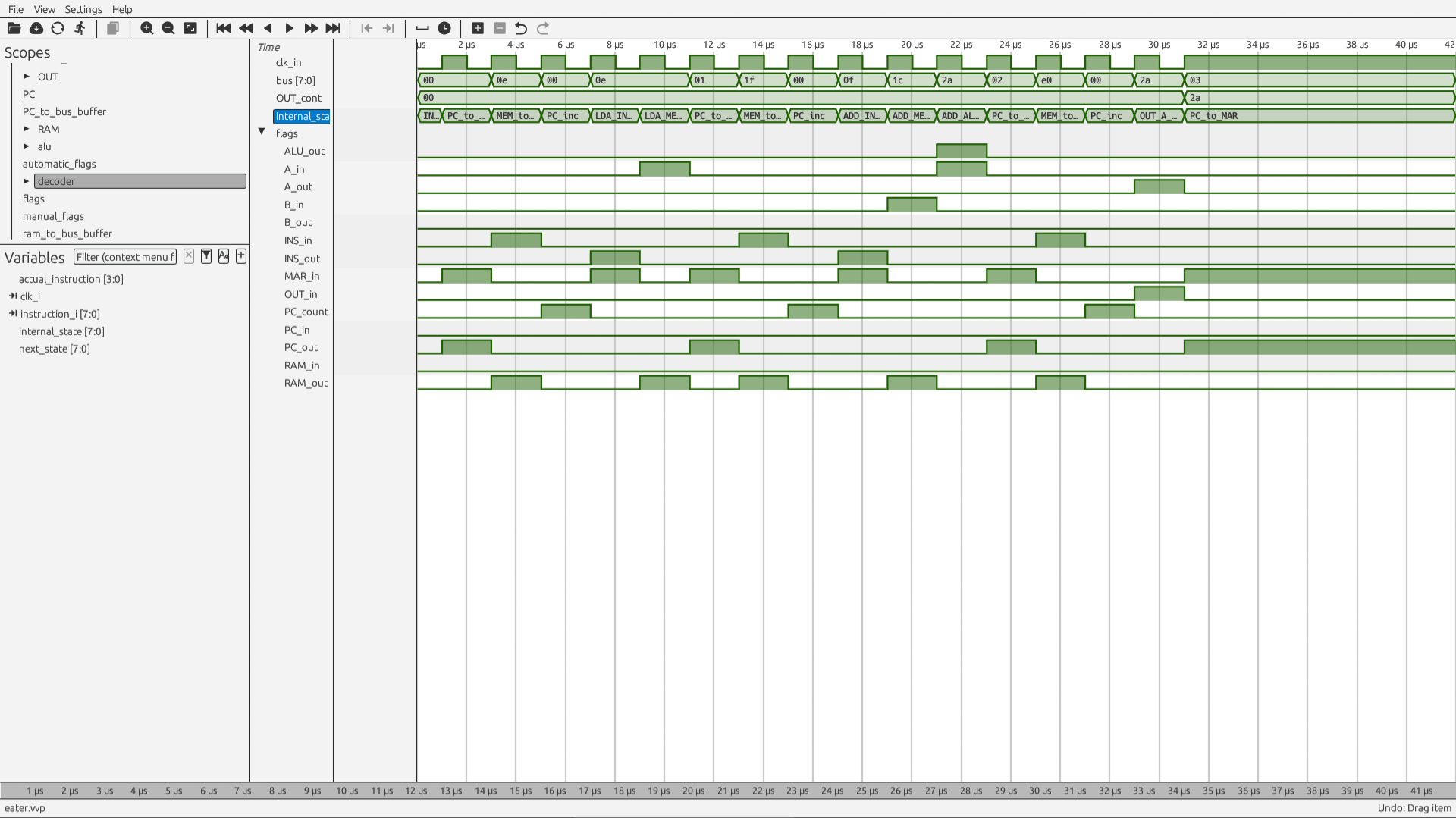
What’s nice, I can simulate this and record the waveforms, to get an even better understanding of what exactly happens:
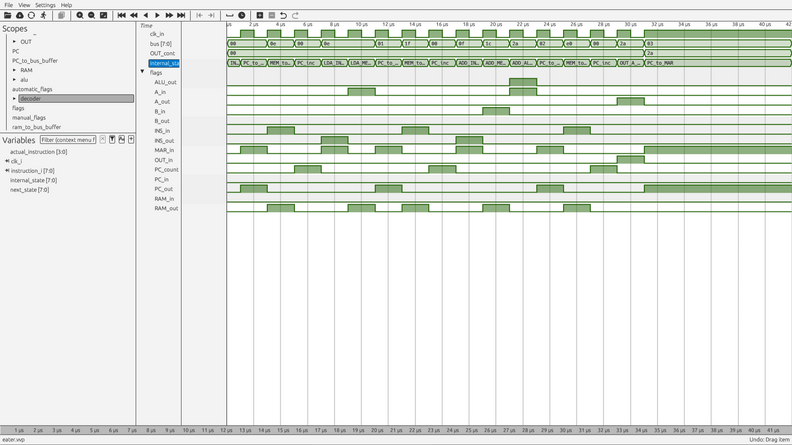
Unfortunately, I couldn’t both get the “full state names” into the picture, as well is the whole program. My screen width is limited. I put the whole stuff on my git repo, though, so feel free to check it out.
Footnotes
-
Using Passkeys under GrapheneOS with KeePassDX
How to properly enable Passkey usage under GrapheneOS with KeePassDX -
Getting started with Verilog
First experiments with Verilog, mostly simuluated. -
FPGA development board
Showing off my FPGA dev board. -
Gadgetbridge won't sync my calendar events to my Pebble
Working around non-working event sync. -
Installing CA certificates on Android (also 16)
Installing CA certificates on Android. -
Activating CSP for my blog
Web stuff! Configuring Content-Security-Policy for my blog. -
Oops, DN42 stopped working
Fixing a broken DN42 DNS after namespacing the processes. -
CPU usage problems on my VPS again
Just a small rant/report on probelems I have with my server.